by Paul White
Introduction to Brown Bears
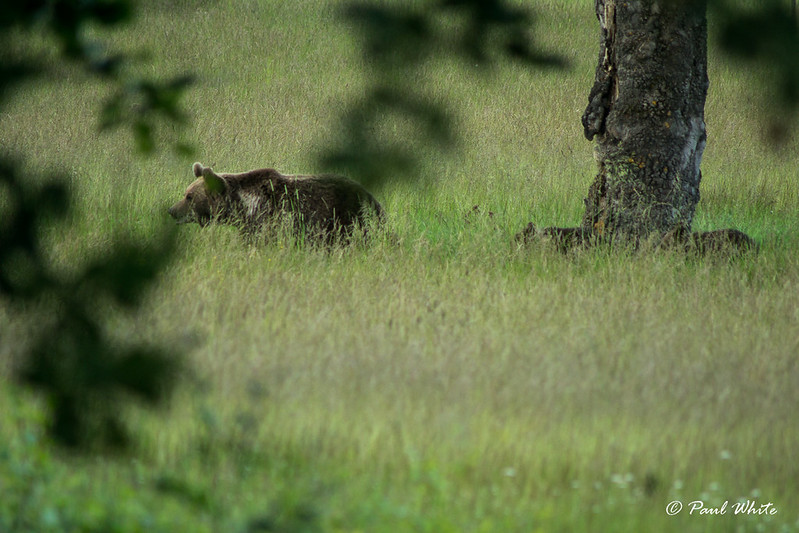
Brown bears (Ursus arctos) have a vast global distribution, reflecting their remarkable adaptability to diverse habitats. Worldwide, their population is estimated at approximately 200,000 individuals.1 In Europe, Romania hosts the largest population outside Russia. A major EU-funded genetic study (2021–2025), analysing over 24,000 non-invasive samples, estimates the population at between 10,419 and 12,770 bears in the Romanian Carpathians — almost twice the long-accepted figure of around 6,000–8,000 from older methods.2 However, some conservationists caution that, even with modern genetic techniques, it can still be difficult to get a completely accurate count because bears are wide-ranging, secretive animals that are hard to sample across such a large and rugged landscape.3 These bears rank among the largest living carnivores, with males reaching up to 350 kg and females up to 200 kg; the largest recorded specimen in Romania weighed 480 kg. Adult males are typically 8–10% larger than females. They possess acute hearing, an exceptional sense of smell, and can live up to 30 years in the wild.
Is the Carpathian Ecosystem in Good Health?
Bear biologist Chris Morgan describes bears as “great barometers of ecosystem health,” noting that “what’s good for bears is good for people.”4 Their reliance on expansive natural areas positions them as key indicators for broader wildlife conservation. With such substantial bear numbers in the Carpathians, does this signal a thriving ecosystem?
Human influences complicate the picture. While I agree with Morgan, some biologists argue that, before 2016, supplemental feeding by hunters — with calorie-dense, protein-rich baits — allowed bears to thrive near feeding sites without ranging far for natural forage. This may have artificially inflated local populations, even as the wider ecosystem declined.5 (Note: the 2016 trophy-hunting ban should have ended such feeding.)
Romanian forests arguably fared better under Nicolae Ceaușescu’s communist regime, which imposed strict controls on logging. After 1989, many descendants of families dispossessed during communism reclaimed vast tracts of forest. A large proportion of new owners harvest timber aggressively, far outpacing the ecosystem’s ability to recover. Illegal logging and clear-cutting — often inside protected national parks — continue to destroy some of Europe’s last virgin woodlands.6
Are Bears Hunted in Romania?
A thriving trophy-hunting industry existed until the 2016 ban. Rising human–bear conflicts have since led to the reintroduction and steady increase of culling quotas (481 bears authorised in 2024).7 Conservationists remain concerned that older counting methods inflated numbers to justify high quotas, and removing up to 10% annually could threaten long-term viability.3
What Is the Best Method for Counting the Bear Population in Romania?
Traditional visual counts are highly unreliable. Since 2021, EU-funded genetic monitoring using non-invasive hair and scat samples has become the standard. The nationwide census (completed in 2025) analysed over 24,000 samples and produced the current official estimate of 10,419–12,770 bears.2
However, WWF Romania has strongly criticised the scientific rigor of this genetic study.8 In response to the final results announced on 12 December 2025, WWF highlighted major methodological deficiencies incompatible with international scientific standards for non-invasive genetic abundance estimates. Key concerns include the three-year sample collection period, which violates the principle of demographic closure and risks severe overestimation by potentially counting the same individuals multiple times as they move. Additional issues raised are the lack of transparency on genetic markers, error rates, validation procedures, and quality controls; variable sample quality (especially fecal samples prone to degradation); potential bias from collecting in accessible areas like feeding sites; and the risk of "phantom individuals" from degraded DNA leading to incorrect genotypes and inflated counts. WWF stressed that without full methodology details, raw data, and an independent audit, the results are not replicable or robust enough for critical management decisions.8
In a move toward greater transparency, on 15 December 2025 the Ministry of Environment (MMAP) published several synthetic technical reports from the project, including the genetic analysis summary, a proposed national zoning for bear management (with an interactive public map), evaluations of electric fence effectiveness, and a long-term genetic monitoring plan.9 These documents aim to facilitate stakeholder dialogue and inform future regulations, though critics note they are summaries rather than full raw datasets or detailed methodologies.
Is Coexistence Between Humans and Bears Possible?
Transhumant shepherds demonstrate that it is. They employ time-tested, non-lethal methods — livestock guardian dogs, night corrals, and constant vigilance — to protect flocks in bear-rich areas, accepting occasional losses without demanding culls.

In villages the situation is more challenging. Bears regularly enter settlements, yet residents often have no clear helpline or access to proven prevention tools (bear spray, electric fencing, bear-proof bins) that are standard in North America.
For perspective, the Carpathian ecosystem is only slightly larger than the Greater Yellowstone Ecosystem yet supports roughly ten times as many bears.
Example: An Autumn Garden Raid in a Transylvanian Village
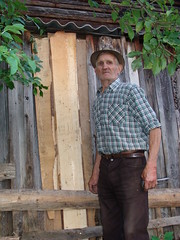
One night Imre’s dog barked frantically. He and his daughter discovered a bear trying to break into the secure sheep annexe, already forcing its head and one forelimb through a broken panel. By releasing the dogs they managed to drive the bear back into the forest. Such incidents are common yet rarely reported unless livestock is killed.
Do Bears Truly Hibernate?
Bears undergo winter lethargy rather than true hibernation. In autumn they frantically raid orchards and gardens to build fat reserves, increasing human encounters. Troublesome individuals may be relocated; dangerous ones are destroyed. In winter, a snow-free tree above a mound usually marks an occupied den — approach with extreme caution and report it to rangers.
Brown Bear Diet and Scat
Diet varies seasonally: spring greens, summer berries, autumn nuts and fruit, plus year-round roots, insects, and occasional mammals. Scat reflects this — dark red in berry season, pale yellow after maize feasts, sometimes containing hair after a meat meal.
Bears and Tourism
The hunting ban shifted economic incentives. Sustainable bear-watching tourism is now growing fast, offering repeat revenue from the same animals rather than a single trophy fee. Former hunters possess ideal skills that transfer perfectly to guiding photographers and wildlife enthusiasts. Success depends on good safety education and easy access to bear spray — measures already standard in North America but still rare in Romania.
References
- IUCN SSC Bear Specialist Group (2024). Global brown bear population estimates. https://iucn.org/our-union/commissions/group/iucn-ssc-bear-specialist-group
- Romania’s brown bear population higher than previously thought, new data shows. Euronews, 15 Apr 2025. https://www.euronews.com/my-europe/2025/04/15/new-data-show-romanias-brown-bear-population-higher-than-previously-thought
- WWF Romania (2023). Romania's Bear Dilemma: A Call for Thoughtful Management, Not Panic. https://wwfcee.org/news/romanias-bear-dilemma-a-call-for-thoughtful-management-not-panic Popescu, V.D. et al. (2016). Overestimation of brown bear abundance in Romania. Journal of Applied Ecology. https://besjournals.onlinelibrary.wiley.com/doi/full/10.1111/1365-2664.12676
- Chris Morgan interview, National Geographic blog, 2011. https://blog.nationalgeographic.org/2011/05/05/bears-of-the-last-frontier-interview-with-chris-morgan-ecologist-author-tv-host/
- Pop, M.I. et al. (2023). Predictors of brown bear predation events on livestock in the Romanian Carpathians. https://conbio.onlinelibrary.wiley.com/doi/10.1111/csp2.12884
- Agent Green & EuroNatur (2024). Massive Logging of Primary Forests in Romania 2021–2024. https://www.euronatur.org/fileadmin/docs/Urwald-Kampagne_Rumaenien/_REPORT_-_Massive_Logging_in_PF_OGF_in_Romania_2021-2024.pdf
- Romanian Ministry of Environment – 2024 culling quotas. https://www.romania-insider.com/president-signs-bear-cull-law-romania-july-2024
- Swenson, J.E. et al. (2000). Action Plan for the Conservation of the Brown Bear in Europe. https://www.researchgate.net/publication/235845137_Action_Plan_for_Conservation_of_the_Brown_Bear_in_Europe_Ursus_arctos
- Huber, D. (2024). Ursus arctos – European assessment. The IUCN Red List. https://www.iucnredlist.org/species/41688/216873475
- Census shows high number of brown bears in Romania. Phys.org, 10 Apr 2025. https://phys.org/news/2025-04-census-high-brown-romania.html
- WWF Romania (16 December 2025). Rezultatele studiului genetic al populației de urs brun – despre nevoia de transparență și rigoare științifică. https://wwf.ro/noutati/rezultatele-studiului-genetic-al-populatiei-de-urs-brun-despre-nevoia-de-transparenta-si-rigoare-stiintifica/
- Ministerul Mediului, Apelor și Pădurilor (15 December 2025). MMAP publică rapoartele rezultate din activitățile proiectului de monitorizare genetică a ursului brun. https://mmediu.ro/comunicare/comunicate-de-presa/mmap-publica-rapoartele-rezultate-din-activitatile-proiectului-de-monitorizare-genetica-a-ursului-brun/
This article was last updated on 17 December 2025.
